Table of Contents
5 Things to Check During Your Jelly Candy Machine Trial Run
Conducting a trial run for your jelly candy machine is a critical step in ensuring optimal performance and product quality in your production line. As a premier food production line factory from China, YTjellycandymachine specializes in delivering state-of-the-art equipment tailored for candy and gummy factories, as well as biscuit producers looking to expand into jelly confections. This process allows you to verify that the machine meets your operational needs, from precise depositing to efficient demolding. For biscuit or candy gummy factories transitioning into jelly production, a meticulous trial run minimizes downtime and maximizes ROI. By focusing on key checkpoints, you can confirm the machine’s reliability, hygiene standards, and output consistency. YTjellycandymachine’s production lines are designed with these trials in mind, incorporating user-friendly controls and robust components for seamless operation.
Transitioning smoothly from setup to testing, the following table provides an at-a-glance overview of the five essential checks. This structured guide helps operators quickly assess performance metrics during the trial.
| Check Area | Parameters to Monitor | Acceptance Criteria |
|---|---|---|
| 1. Temperature Control | Cooking temperature, depositing temperature, cooling zones | ±1°C accuracy; stable across 30-minute run |
| 2. Depositing Accuracy | Depositor nozzle alignment, syrup viscosity, deposit volume | Uniform weight ±0.5g per piece; no air bubbles |
| 3. Molding and Demolding | Starch bed moisture, mold release force, sanding application | 98% defect-free release; even sanding layer |
| 4. Production Speed and Capacity | Machine speed settings, throughput rate, jam frequency | Matches rated output (e.g., 500kg/hr); zero jams |
| 5. Final Product Quality and Hygiene | Texture firmness, visual appearance, sanitation surfaces | Consistent chewiness; meets HACCP standards |
With this overview in hand, let’s delve deeper into each check using a detailed numbered list. This approach ensures comprehensive evaluation, guiding you step-by-step through the trial run process championed by YTjellycandymachine equipment.
Temperature Control Verification. Begin by calibrating all temperature sensors in the cooking kettle, depositor, and cooling tunnel. Jelly candy production demands precise heat management to achieve the right gelatin bloom and syrup consistency. During the trial, monitor digital readouts and use infrared thermometers for cross-verification. Run a 20-kg batch and observe fluctuations; ideal stability prevents crystallization or undercooking. For biscuit or gummy factories adapting this setup, note how YTjellycandymachine’s PID controllers maintain ±1°C precision, reducing energy waste by up to 15%. Log data every five minutes to identify drifts early, ensuring syrup reaches 105-110°C for cooking and 80-85°C for depositing. This foundational check sets the stage for subsequent stages.
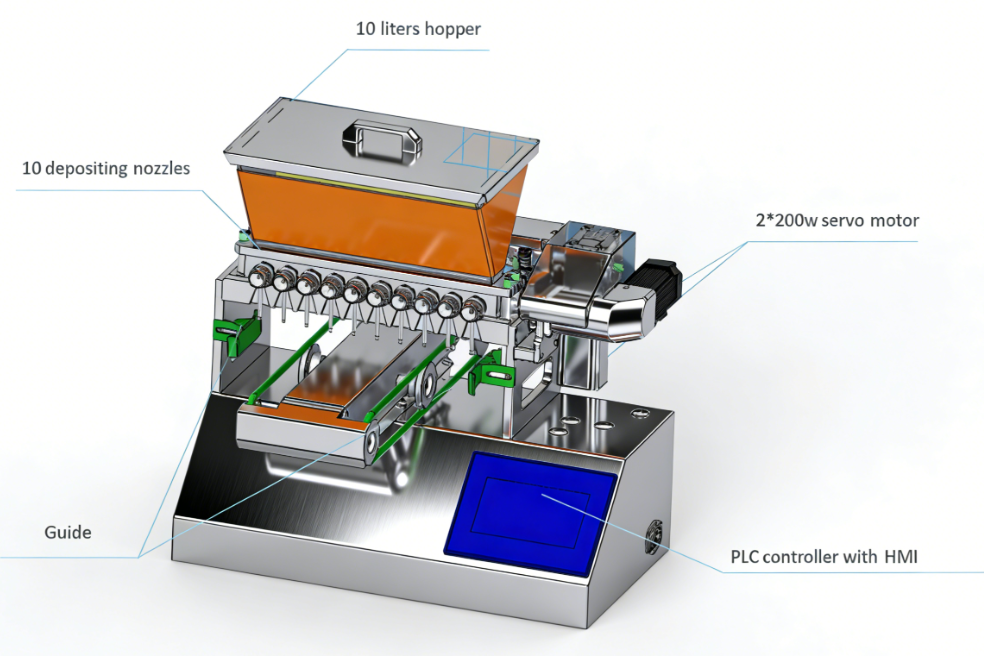
Depositing Accuracy Assessment. Next, focus on the rotary depositor’s performance, a hallmark of YTjellycandymachine production lines. Feed prepared syrup and watch for even piston strokes and nozzle precision. Measure 100 samples for weight uniformity—target under 0.5g variance—and inspect for tailing or bubbles, which indicate viscosity issues. Adjust servo motors if needed, then rerun at full speed. Candy gummy factories will appreciate this precision mirroring their own needs, while biscuit producers benefit from adaptable molds for shaped jellies. Transitional adjustments here ensure downstream molding succeeds without overflows, maintaining line efficiency at 95% or higher.
Molding and Demolding Efficiency. Moving to the starch mogul, verify bed preparation by checking moisture levels (18-20%) and impression depth. Deposit into molds, allow 4-6 hours of setting, then activate vibration and air blowers for demolding. Count rejects; aim for less than 2% sticking or deformities. YTjellycandymachine’s automated starch recycling system shines here, minimizing waste. Examine surfaces for residue, and test sanding drums for uniform coating. This step is crucial for factories scaling from biscuits, as flawless demolding directly impacts packaging readiness and shelf-life stability.
- Production Speed and Capacity Evaluation. Ramp up to nominal speed post-initial batches, timing a one-hour run to confirm output against specs—typically 300-800kg/hr depending on model. Monitor conveyor synchronization and detect any jams via sensors. YTjellycandymachine integrates variable frequency drives for flexible speeds, ideal for mixed production runs in gummy or biscuit facilities. Calculate OEE (Overall Equipment Effectiveness) using uptime, speed, and quality rates; target over 85%. Fine-tune if throughput lags, ensuring scalability for high-volume demands.
Final Product Quality and Hygiene Inspection. Conclude checks by sampling finished jellies for texture (using a texture analyzer if available), weight, and appearance under magnification. Conduct swab tests on contact surfaces to confirm sanitation. YTjellycandymachine’s stainless-steel construction and CIP (Clean-In-Place) features exceed food safety norms. Verify no migration or off-flavors, then package a batch for shelf-testing. This holistic review guarantees market-ready products for your candy gummy line expansions.
In summary, rigorously applying these five checks during your jelly candy machine trial run will unlock peak performance and confidence in your investment. YTjellycandymachine invites biscuit and candy gummy factories worldwide to experience our China-engineered excellence—contact us for a customized demo. By prioritizing these verifications, you’ll achieve consistent, high-quality jelly output, driving business growth efficiently.
Last Updated on June 23, 2026 by YTjellycandymachine